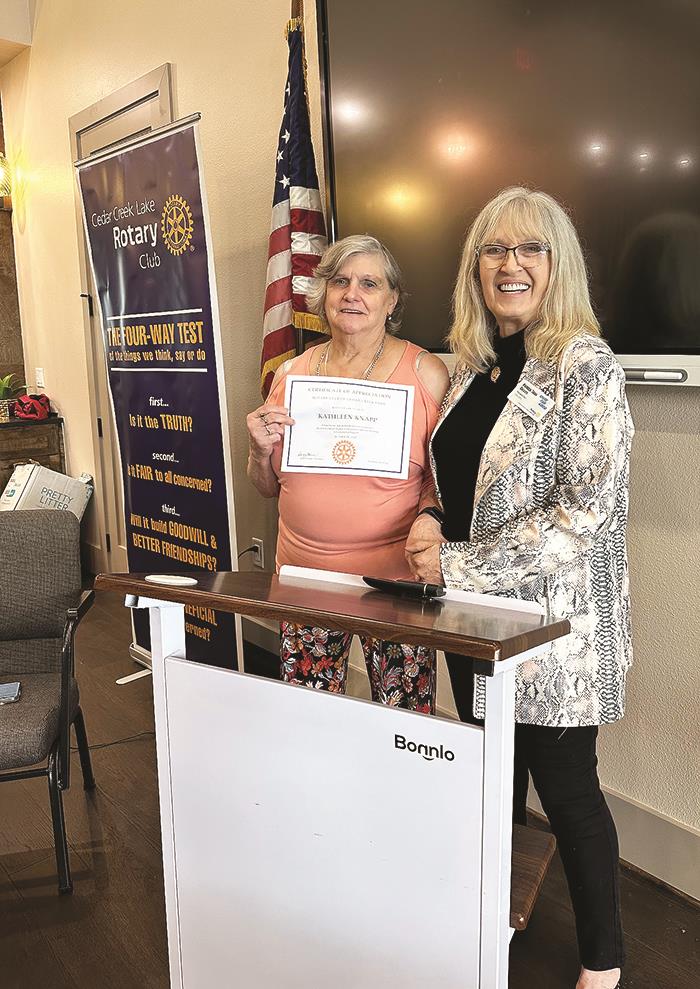
Rotary Club of Cedar Creek Lake President Elect Trish Deeds (right) presents a
certificate to Kathleen “Kat” Knapp for being the guest speaker Oct. 24. Knapp gave an
emotional speech, sharing her experience as a polio survivor. Rotary will dedicate a
book in her honor to be given as part of the club’s Reading is Fundamental book
giveaway.
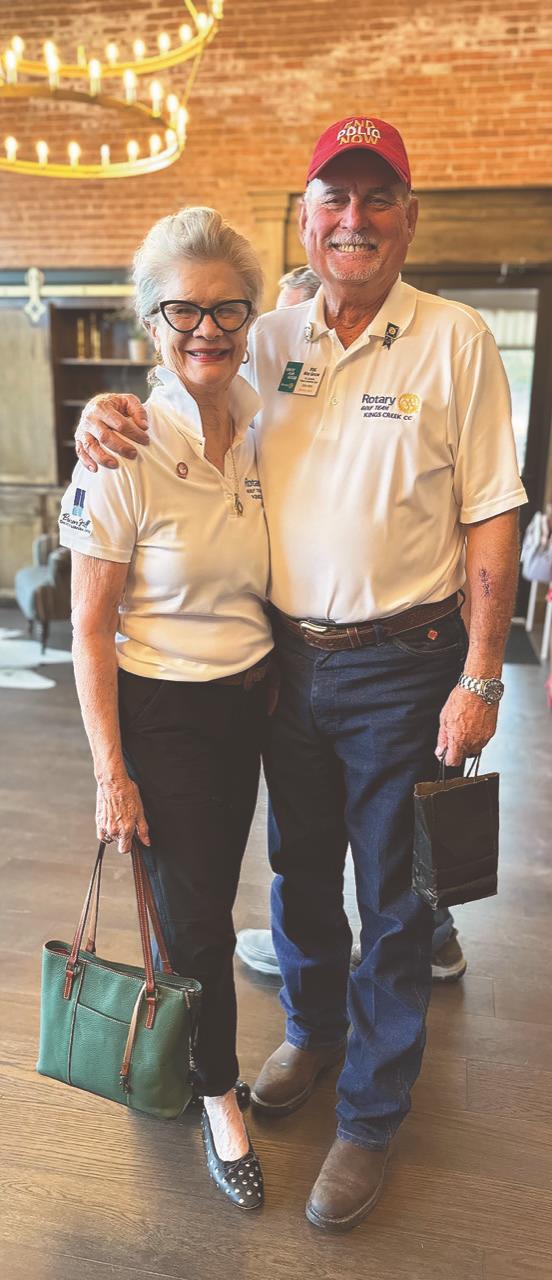
Past District 5830 Governor Mike Groom (right) with wife Andrea Groom support Polio
Plus, Rotary’s effort to eradicate polio. Groom, during his tenure as district governor, led
a campaign to raise funds for Polio Plus and continues to speak to clubs, encouraging
members to give to this worthy cause.
certificate to Kathleen “Kat” Knapp for being the guest speaker Oct. 24. Knapp gave an
emotional speech, sharing her experience as a polio survivor. Rotary will dedicate a
book in her honor to be given as part of the club’s Reading is Fundamental book
giveaway.
Past District 5830 Governor Mike Groom (right) with wife Andrea Groom support Polio
Plus, Rotary’s effort to eradicate polio. Groom, during his tenure as district governor, led
a campaign to raise funds for Polio Plus and continues to speak to clubs, encouraging
members to give to this worthy cause.
The Rotary Club of Cedar Creek Lake heard a special presentation Oct. 24
when members met for their regularly scheduled Friday meeting at the Mason Eubank
Hall in Mabank. Past District Governor Mike Groom spoke to the group regarding
Rotary’s Polio Plus Program.
Rotary’s fight to eradicate polio began over 35 years ago, Groom stated, with the first
effort in the Philippines to inoculate children as a founding partner of the Global Polio
Eradication Initiative (GPEI). At that time, there were an estimated 350,000 cases
worldwide in 125 countries. In 1985, Rotary launched PolioPlus, the first and largest
internationally coordinated private-sector support of a public health initiative, with an
initial fundraising target of 100 million dollars.
Rotary has since contributed 2.1 billion dollars and countless volunteer hours to protect
nearly 3 billion children in 122 countries from this paralyzing disease. Rotary’s advocacy
efforts have helped to raise 10 billion dollars by governments to assist in this effort.
For Kathleen “Kat” Knapp, Rotary’s efforts to eradicate this disease are intensely
personal. Knapp told the group she was a five year old child, playing an angel onstage
when she collapsed like a ragdoll and was rushed to the hospital. Although her
diagnosis was initially “unknown,” it was soon learned that she had polio, a dreaded
disease known to affect the muscles and nerves first within the lung and then the
extremities.
Knapp said, “No matter how many trips to the hospital over the years, I can remember
this particular one, more clearly than most. Waking up, much later within this strange
machine that surrounded my small frame, looking through protective glass and seeing
my mom and dad trying their best to smile and wave at me.”
Knapp was placed in an iron lung, a machine she describes like an MRI machine, but
tighter with very little room to move around. She spent the next six months in the
hospital, exercising to strengthen her legs and then returned to the iron lung where she
spent most of her time. Knapp said that in 1952, when she was diagnosed, there were
approximately 58,000 cases of polio reported in the United States with over 3,200
resulting in death and 21,000 left with mild to severe paralysis.
Knapp says she was “one of the lucky ones, able to go home with mild paralysis and
breathing problems. Others suffered permanent muscle and nerve damage in their
extremities leaving them handicapped. While some of our new friends didn’t make it,
when members met for their regularly scheduled Friday meeting at the Mason Eubank
Hall in Mabank. Past District Governor Mike Groom spoke to the group regarding
Rotary’s Polio Plus Program.
Rotary’s fight to eradicate polio began over 35 years ago, Groom stated, with the first
effort in the Philippines to inoculate children as a founding partner of the Global Polio
Eradication Initiative (GPEI). At that time, there were an estimated 350,000 cases
worldwide in 125 countries. In 1985, Rotary launched PolioPlus, the first and largest
internationally coordinated private-sector support of a public health initiative, with an
initial fundraising target of 100 million dollars.
Rotary has since contributed 2.1 billion dollars and countless volunteer hours to protect
nearly 3 billion children in 122 countries from this paralyzing disease. Rotary’s advocacy
efforts have helped to raise 10 billion dollars by governments to assist in this effort.
For Kathleen “Kat” Knapp, Rotary’s efforts to eradicate this disease are intensely
personal. Knapp told the group she was a five year old child, playing an angel onstage
when she collapsed like a ragdoll and was rushed to the hospital. Although her
diagnosis was initially “unknown,” it was soon learned that she had polio, a dreaded
disease known to affect the muscles and nerves first within the lung and then the
extremities.
Knapp said, “No matter how many trips to the hospital over the years, I can remember
this particular one, more clearly than most. Waking up, much later within this strange
machine that surrounded my small frame, looking through protective glass and seeing
my mom and dad trying their best to smile and wave at me.”
Knapp was placed in an iron lung, a machine she describes like an MRI machine, but
tighter with very little room to move around. She spent the next six months in the
hospital, exercising to strengthen her legs and then returned to the iron lung where she
spent most of her time. Knapp said that in 1952, when she was diagnosed, there were
approximately 58,000 cases of polio reported in the United States with over 3,200
resulting in death and 21,000 left with mild to severe paralysis.
Knapp says she was “one of the lucky ones, able to go home with mild paralysis and
breathing problems. Others suffered permanent muscle and nerve damage in their
extremities leaving them handicapped. While some of our new friends didn’t make it,
their lungs were too restricted and ultimately ended their life, which was scary for a five-
year-old who didn’t really understand death.”
Knapp shared that she is among the 15-20% of survivors to develop Post-Polio
Syndrome (PPS), with a reported 20 million cases worldwide in 2004. Cases are
reported in clinical settings as a variety of new or worsening symptoms, such as fatigue,
muscle weakness, pain, and difficulty breathing, that emerge 15 to 40 years or more
after the initial polio infection. The exact number is hard to determine because PPS is a
diagnosis of exclusion that can be difficult to distinguish from normal aging. The
combination, intensity, and progression of symptoms vary significantly from person to
person. Research is ongoing.
There were 38 cases of paralyzing polio (wild polio) reported in 2025 as of Oct. 14,
down from 99 in 2024. Twenty-nine of these are in Pakistan, seven in Afghanistan.
There were 160 cases of vaccine derived polio reported in 2025, which is mutated and
somewhat less severe. Most of these are in Africa.
Groom shared that GPEI released the 2026 Action Plan: A Smarter, Leaner Blueprint to
End Polio – a comprehensive roadmap to streamline operations and sustain momentum
toward a polio-free world in light of a 30% budget reduction next year. This includes:
Targeting investments to the highest risk areas of Afghanistan and Pakistan, the
last remaining strongholds of wild poliovirus, and outbreak zones in Southern and
Central Africa, the Horn of Africa and Lake Chad Basin.
Expanding new vaccination strategies, including delivery of the novel oral polio
vaccine type 2 (nOPV2) in between campaign rounds and fractional dose
inactivated polio vaccine (fIPV) during campaigns to close immunity gaps in the
hardest to reach places.
More systematically integration with health partners, such as measles and
nutrition services, to reach the most vulnerable children and strengthen routine
immunization.
Enhancing national surveillance and lab capacities to ensure rapid detection and
response to outbreaks, even as budgets tighten.
Groom states “there is still a $1.7 billion funding gap for GPEI’s 2022-29 strategic plan
with full financial support needed from donors, governments and partners to close this
gap, reinforce global health security and ensure no child is left behind.”
Knapp said she is extremely grateful for Rotary’s role in fighting this dread disease. For
more information, visit rotary.org.
year-old who didn’t really understand death.”
Knapp shared that she is among the 15-20% of survivors to develop Post-Polio
Syndrome (PPS), with a reported 20 million cases worldwide in 2004. Cases are
reported in clinical settings as a variety of new or worsening symptoms, such as fatigue,
muscle weakness, pain, and difficulty breathing, that emerge 15 to 40 years or more
after the initial polio infection. The exact number is hard to determine because PPS is a
diagnosis of exclusion that can be difficult to distinguish from normal aging. The
combination, intensity, and progression of symptoms vary significantly from person to
person. Research is ongoing.
There were 38 cases of paralyzing polio (wild polio) reported in 2025 as of Oct. 14,
down from 99 in 2024. Twenty-nine of these are in Pakistan, seven in Afghanistan.
There were 160 cases of vaccine derived polio reported in 2025, which is mutated and
somewhat less severe. Most of these are in Africa.
Groom shared that GPEI released the 2026 Action Plan: A Smarter, Leaner Blueprint to
End Polio – a comprehensive roadmap to streamline operations and sustain momentum
toward a polio-free world in light of a 30% budget reduction next year. This includes:
Targeting investments to the highest risk areas of Afghanistan and Pakistan, the
last remaining strongholds of wild poliovirus, and outbreak zones in Southern and
Central Africa, the Horn of Africa and Lake Chad Basin.
Expanding new vaccination strategies, including delivery of the novel oral polio
vaccine type 2 (nOPV2) in between campaign rounds and fractional dose
inactivated polio vaccine (fIPV) during campaigns to close immunity gaps in the
hardest to reach places.
More systematically integration with health partners, such as measles and
nutrition services, to reach the most vulnerable children and strengthen routine
immunization.
Enhancing national surveillance and lab capacities to ensure rapid detection and
response to outbreaks, even as budgets tighten.
Groom states “there is still a $1.7 billion funding gap for GPEI’s 2022-29 strategic plan
with full financial support needed from donors, governments and partners to close this
gap, reinforce global health security and ensure no child is left behind.”
Knapp said she is extremely grateful for Rotary’s role in fighting this dread disease. For
more information, visit rotary.org.
By Denise York